


Markets rebounded as Nvidia’s two possible futures come into focus
Markets rebounded last week and the rotation that has been building for a month continued, with Europe up around 4% and Europe and Australia the strongest performers of recent weeks. The more interesting development was in rates: Australian ten-year yields dipped below US ten-years for the first time in over a year, finishing at 5.12% against 5.14%,
the US up 28 basis points on the week against Australia's 14. Next-meeting pricing has the Fed at 106% and the ECB at 92%, but the RBA at just 4% for 8 December, perhaps three more Fed hikes by the end of next year, one more and done from the ECB, and Australian rates flat this year with a cut priced for next. That divergence explains the softer Australian dollar, whose silver lining is that it cushions unhedged overseas holdings.
Credit markets have been reassuringly quiet, with spreads grinding tighter again last week across the board, Australian credit at 83 basis points, US investment grade at 86, US high yield at 316. The exception is where the issuance has been: technology investment grade trades wide of the market at 150 basis points against 121, on hyperscaler supply of US$349 billion year to date. A bifurcated index, but no contagion into credit generally. Locally, consumer sentiment and corporate profitability have softened, housing lending is slowing, and the banks reporting so far show broadly flat revenue. With central banks quiet until December, attention turns to corporate results.
Earnings season: ending with a bang
The US third quarter was very strong, and almost entirely expected, which is why it earned so little reward. Blended earnings growth was 31.9% on revenue up 14.4%, with 84% of companies beating against a five-year average of 78%. But the aggregate surprise was just 3.1%, the smallest since late 2022. Earnings strength already in the consensus estimates does not move prices: So far this reporting season Goldman's ex AI-linked basket rose about 5% through the season while the S&P 500 fell 3%, led down by the chip names that produced most of the growth.
The mix underneath is shifting. AI infrastructure grew earnings around 80%, more than five times the roughly 15% managed by the rest of the index. Yet the Magnificent Seven (+22.6%) trailed the other 493 (+32.6%) for the first time since 2022, even while hyperscaler cloud revenue accelerated — Google Cloud up 103%, Azure 48%, AWS 39%. That matters: if the midterm result slows the build-out, the compute that already exists becomes more valuable, so the hyperscalers have counterintuitively become a steadying influence ( and a potential diversifier!) Outside the pure AI trade (sort of), energy earnings rose 138% and industrials and materials posted steady double-digit growth, so the broadening looks real rather than merely a derivative of the AI trade. The peak, though, is behind us: consensus has growth fading from 28% in the fourth quarter to 3% by mid-2027 — a Wile E. Coyote moment at first glance, but already forecast and therefore in the price. The question is the valley between capital expenditure and the revenue it is meant to produce.
Which brings us to NVIDIA, the lightning rod, reporting on 17 November under interim chief executive Colette Kress. Three pressures are stacked on it: whether demand arrives soon enough, whether the capital funding the rollout is endless, and now a governance shock after Jensen Huang’s resignation. The shares are at 162.85 US dollars, down 33% from their high, on roughly ten times the following year’s earnings. We have mapped the outcomes as two fans rather than one range. In the first, business as usual, the build continues broadly as expected and the argument is only about speed: upside near 480, consensus around 375, and even a muddle-through, of the sort SoftBank’s write-off of pre-ordered gas turbines already hints at, still around 223 and above today’s price. In the second, the vendor-financing loop goes into reverse. NVIDIA has helped fund its own customers through 99 billion of equity stakes and 36 billion of capacity backstops, against 279 billion of supply orders, circular but benign while the train rolls, rather less so if those arrangements start appearing on balance sheets as liabilities. Those paths run to roughly 115 on an uneasy digestion, 50 if the financing backfires, and 19 in a Cisco-style bust. Both fans are plausible, and the most leveraged neoclouds are where the early evidence will show.
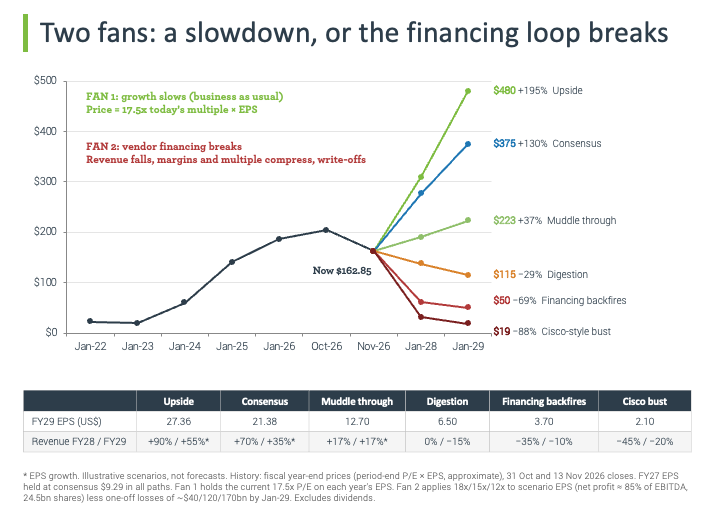
The overall message, then, is that this is a muddle-through market. The reasoned position on AI we think is that the trade probably has legs but could also end abruptly, and we cannot know which fan we are on until the signposts tell us. That is precisely the argument for holding AI exposure and being properly diversified elsewhere, rather than choosing between them — favouring the parts of the complex that win either way, while being wary of single-project exposure in land, power and smaller supply-chain names.