


Scenarios and what they are actually for
Why we are doing this again
A few adviser groups have asked us the same question in the past month: where are your scenarios? It is a fair question and we have been slower to answer it than we might have been, for a reason worth admitting. The last time we built a full scenario framework was around the Hormuz conflict. We named four outcomes, attached probabilities, derived implied oil prices and worked through the portfolio consequences. The analysis was careful and the conclusion was, in the event, beside the point. The oil price did not dictate much of anything. Equity markets simply declined to care. That experience made us wary of hanging too much on any single construction, and we would rather say so at the outset than present this with more confidence than it deserves.
What are scenarios?
Scenarios are not forecasts and we are not offering them as such. They are a way of asking what a portfolio does if the world goes a particular way, so that nobody is surprised by an outcome that was always a possibility.
The scenarios
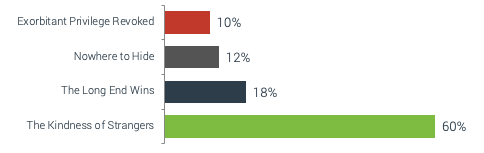
•The Kindness of Strangers — Higher long rates slow things modestly without breaking anything, partly because surplus nations keep recycling into US assets.
•The Long End Wins — Rates finally bite, growth rolls over and inflation falls with it.
•Nowhere to Hide — Inflation stays sticky while growth weakens - the one case where duration does not diversify.
•Exorbitant Privilege Revoked — Surplus nations stop recycling - not necessarily selling, just not buying as much.
What the current work says
We have run four scenarios across the InvestSense Diversified range, and more recently across the Betashares DAA portfolios as a cross-check. The conclusion is less dramatic than the exercise might suggest.
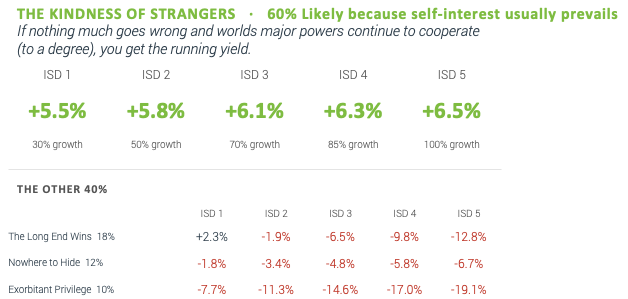
If nothing much goes wrong, you get the running yield. That is roughly it. Bond yields have risen to the point where a diversified portfolio earns a reasonable return simply by holding what it holds, and the base case does not require anything clever to happen. Equity markets are at all time highs.
What moves portfolios meaningfully from here is mostly unpleasant. Either inflation proves sticky and rates stay higher than markets expect, or the rate rises already delivered start to bite and growth slows. Neither is a disaster, and neither is our central expectation. But it does mean the distribution is asymmetric, and we would rather be straight about that than manufacture a symmetrical-looking picture.
We also ask ourselves whether there should be a more bullish case, and it is a reasonable challenge, a framework with more downside branches than upside ones deserves scrutiny. Our answer is that the cap on the upside is valuation: relatively high multiples on what look like peak earnings. If that is wrong, the upside is better than we show. We have left the base case carrying its own upside tail rather than inventing a fifth scenario, which is a judgement rather than a fact.
One further finding is worth reporting because it is uncomfortable. Running the same scenarios across a quite differently-constructed suite produces broadly similar answers. Where outcomes do differ, the differences are incremental rather than transformational, a little better in a drawdown, not dramatically so. This is not 2021, when we had genuine conviction that if the world went a certain way our portfolios would outperform due to being substantially underweight duration and US equities. That feels coherent with a muddle through scenario but we think there might also be some upside to being in the way of the rotation trade where cheaper assets with good quality earrings show more downside resilience if things go south but also some upside if economic momentum broadens.
How to use it with clients
A table of scenario outcomes contains more red numbers than green, because three of the four scenarios are adverse. Shown cold, that reads as alarming, and it is not what the analysis says. Clients do not naturally weigh by probability. The same instinct that makes someone ask about the holding that is down thirty per cent while ignoring the one that is up sixty and eight times the size.
Our view is that the table belongs in investment committee papers and the picture belongs in client conversations. What the framework is for, in front of a client, is demonstrating that we are not blind to the risks, not cataloguing them.
It is also worth putting the current environment in context. Markets dislike rapid changes in interest rates far more than they dislike the level. The move from one per cent to four over 2021 and 2022 was punishing; a period of stability at a higher level is something markets can absorb. Rates pushing decisively above six per cent would be a genuine problem for most economies. Equally, if inflation moderates and Middle East supply pressures ease, yields fall and markets will like it.
Which leaves a more constructive conclusion than the red numbers suggest. We would far rather be invested in today's starting conditions than in 2021's, when low yields and high valuations left nowhere to go. Today, whatever an adviser decides to do — including deciding to be cautious — they are at least paid for it.
Where this goes next
Advisers may wish to treat the current scenario set as a conversation starter rather than a conclusion and reassure clients on two fronts. Firstly, while markets have had a good run and there are some worrying headlines there are no clear signs yet that the tide is about to turn. Therefore it is reasonable to expect a reasonable return in line with long-term averages. Therefore it is reasonable to expect reasonable but subdued returns over the next year. Secondly, the InvestSense team and the various IC's we work with a very much alive to the potential risks embedded in geopolitics, inflation dynamics and recession/credit worries and if the situation changes so will portfolios. In the meantime we believe most portfolios we work with have some inbuilt resilience having been trimmed from the most exuberantly valued areas of the market like junk bonds and chip manufacturers.